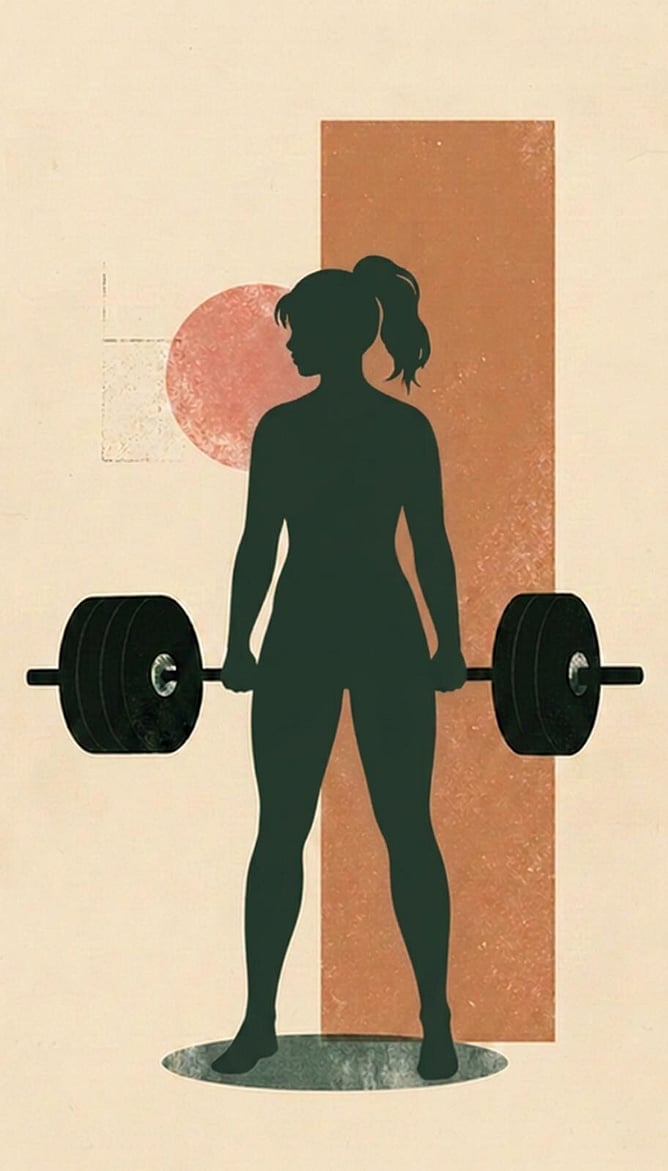
There's a particular kind of nervous that walks into a weight room for the first time. Almost every woman who's ever picked up a barbell for the first time has stood in front of the rack, hand hovering, thinking some version of: What if I look ridiculous? What if I hurt myself? What if everyone can tell I don't know what I'm doing?
Let's talk about where that fear actually comes from and why it's not a reason to stay away from the weights room. If anything, it's the reason to walk in.
The fear isn't really about the weights
Most women who feel nervous about lifting aren't afraid of the bar itself. They're afraid of being seen not knowing something. Of doing it "wrong." Of taking up space in a room that, for a long time, wasn't built with them in mind.
Add to that decades of messaging that women's bodies exist to be shrunk, not strengthened, and it makes complete sense that walking up to a squat rack can feel like walking into hostile territory. You were never taught this. Of course it feels foreign.
That's not a personal failing. That's just what happens when an entire culture teaches you to make yourself smaller and then expects you to feel at home holding something heavy.
What's actually true about starting as a beginner
A few things worth sitting with:
Nobody in that room is watching you as closely as you think. Most people lifting are deeply focused on their own set, their own breath, their own count. The spotlight you're imagining is almost entirely internal.
Every capable lifter you admire started exactly where you are. Technique is learned, not innate. The woman confidently deadlifting next to you once didn't know what a hip hinge was either.
Your body is more capable than diet culture ever gave it credit for. Bones get denser under load. Joints get more stable, not less. Muscle doesn't just change how you look, it changes how confidently you move through the rest of your life.
Starting light is not starting behind. An empty barbell, a light dumbbell, a resistance band. these are legitimate training tools, not consolation prizes. Strength is built in layers, and the first layer is simply showing up and learning the pattern.
How to actually move through it
Start with pattern, not weight. Before you worry about how much you're lifting, get comfortable with how you're moving: the squat, the hinge, the push, the pull. Confidence in the movement comes before confidence in the load.
Ask for the walkthrough. A good trainer expects questions and wants you asking them. "Can you show me that again?" is one of the most useful sentences in a weight room, at any age, at any level.
Let the first few sessions be about familiarity, not performance. You're not auditioning. You're getting your nervous system used to a new environment. That alone is the win in week one.
Notice the story you're telling yourself. If the inner voice is saying “I don't belong here,”that's worth naming as a thought, not a fact.
Track effort, not perfection. Did you show up? Did you try the movement? Did you ask for help when you needed it? That's the whole scoreboard, especially at the start.
The other side of the fear
What nobody tells you before you start is that the fear doesn't fully disappear before you begin. It gets smaller because you begin. Every session where you show up anyway is proof to your body and your brain that you're someone who does hard, unfamiliar things and comes out the other side more capable.
That's not really about the weights either. That's about what happens to the rest of your life when you know, in yourself, that you're strong enough to try.
You don't need to feel ready. You just need to walk in.