At Life Co-Lab, we have a training philosophy that surprises most women when they first walk in: we're not trying to wreck you. For many women, the fear of punishing sessions is exactly what stops them from starting in the first place.
You won't leave every session wrung out, and you won't spend all your days wincing on the stairs. That isn't because we go easy. It's because we've learned what actually builds strength, and how much of it is invisible.
• We teach the pattern before we add the load. The squat, the hinge, the push and the pull come first. Confidence in the movement comes before confidence in the weight.
• We value quality over punishment. Eight controlled reps beat fifteen ragged ones every time.
• We build strength you can use. That means carrying, lifting and moving through your life with ease, not just surviving a workout.
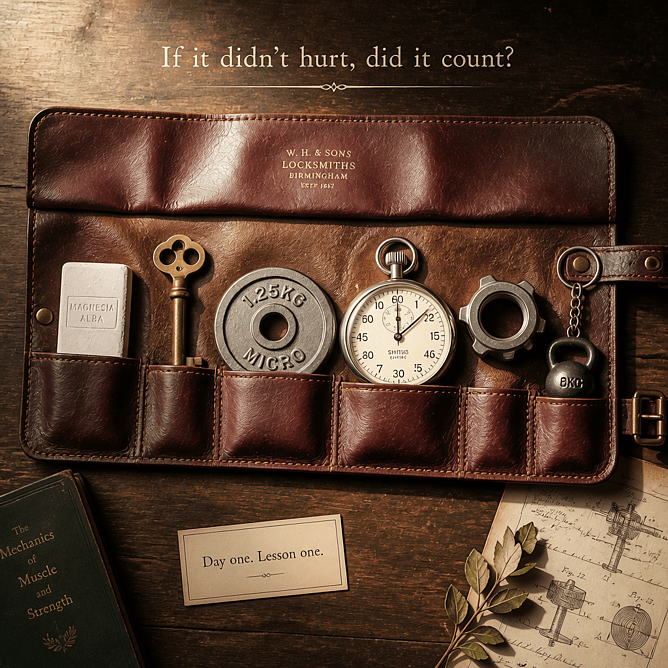
But surely if it didn't hurt, it didn't count?
There's a name for that instinct.
The Locksmith Paradox
Writer Sahil Bloom frames it as a thought experiment, drawn from a story by behavioural economist Dan Ariely.
You're locked out of your home and call a locksmith. He's clearly new to the job, and it takes him an hour to get you in. He charges $100, and you pay gladly. He's earned it.
A year later, you're locked out again. Same locksmith, now experienced. He has you inside in two minutes and charges the same $100. This time, you're annoyed.
The result was identical. Only the visible effort changed. Bloom calls this the Locksmith Paradox: we undervalue an outcome when we can't see much effort behind it.
Strength is hard to judge. It builds slowly and quietly, so we reach for the proxies we can feel.
The proxies that lie to us
• Soreness mostly reflects novelty, not effectiveness. It fades as your body adapts, which is exactly what you want.
• Sweat is thermoregulation. In perimenopause, a narrowed thermoneutral zone means you sweat at smaller temperature shifts. It tells you about your hypothalamus, not your hamstrings.
• Exhaustion feels heroic, but finishing sets with one to three reps in the tank delivers comparable gains with far less fatigue.
• Long rests aren't lazy. Two to three minutes between heavy sets supports greater strength than rushing.
What's actually happening in your first weeks
• Your nervous system is learning. Early strength gains are mostly neural: your brain learning to recruit muscle fibres and coordinate them. Nothing looks different, but this is the foundation everything else is built on.
• Your muscle needs a clear signal. Declining oestrogen contributes to anabolic resistance, so muscle responds less readily in midlife. Well-executed load and good recovery send a clearer message than exhaustion.
• Your recovery matters as much as your session. Midlife sleep is often lighter, with less of the deep sleep that drives repair. Training that leaves you depleted on top of a full life works against you.
The woman who makes it look easy
You'll see her: the woman who deadlifts something heavy without any visible fuss. She isn't lucky. Her ease is hundreds of hours you didn't see.
One day that will be you. When a weight that once felt heavy moves cleanly, don't discount it because it didn't hurt. That ease is the result.
How to measure your progress
• Track load and reps, not sweat.
• Notice when a movement starts to feel natural.
• Watch for life markers: lifting a suitcase overhead, getting off the floor without your hands, sleeping better.
• Ask questions. Understanding why is part of the training.
Just remember the lift is no less yours because it looked easy.