The skill we teach every client: How to actually listen to your body when you train
At Life Co-Lab, one of the things we place great emphasis on, has nothing to do with reps or weight. It's a skill: learning to read your own body well enough to know how hard you should be training, today, right now. We call it autoregulation, and once a client understands it, weight training stops feeling like a test they can pass or fail, it becomes a conversation they're equipped to have with their own body, for the rest of their life.
This skill matters for everyone. But it's a genuine game-changer for women in perimenopause and beyond. The body is simply operating with more day-to-day range than it used to: recovery capacity, sleep quality, and energy availability can shift meaningfully from one session to the next, sometimes for reasons that have nothing to do with how hard you trained the day before. That's not a problem to manage around. It's just new information.
What autoregulation actually is:
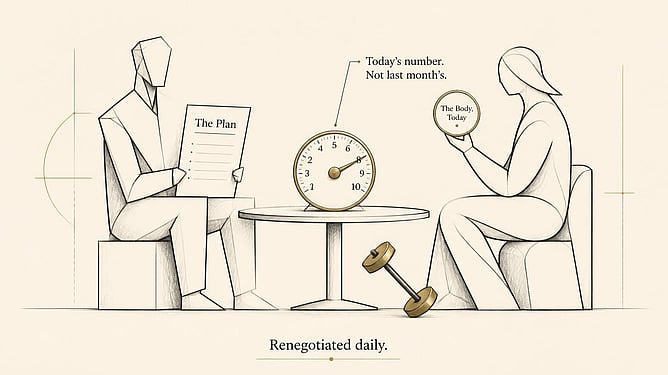
Most training plans assume your capacity is fixed weeks in advance: 4 sets of 10 at a set weight, decided by a number you hit months ago. Autoregulation flips that. The plan still tells you the exercise, the sets, the rep range, the structure doesn't move. What flexes is the load, based on a simple scale called RPE (Rating of perceived exertion): after a set, you ask how much you had left. Two more reps in the tank? That's an 8. Nothing left? That's a 10. Today's weight is whatever gets you to the target, not a number written down on a different day, in a different body-state.
Studies have found that autoregulated training outperformed fixed-percentage programming for building strength, precisely because it matches the stimulus to what the body can produce that day, instead of what a formula assumed months earlier. It's a skill though, not an instinct. Research on beginners shows RPE accuracy takes a few weeks of practice to calibrate.
Why this changes your relationship with training, not just your results:
Here's what a lot of programs get wrong: when a plan assumes fixed output, any day you can't hit the number quietly becomes a referendum on you. Do that for long enough, and it stops being about the workout, it becomes a story: my body is unpredictable, so something's wrong with it.
That's simply not true, and it's not the story we want our clients carrying.
Autoregulation removes this. When the framework itself expects variability, a lower-output day becomes information, not failure. You're not white-knuckling through a number that doesn't belong to today, you're negotiating with your body, the way you would with a training partner who's actually paying attention. That's a genuinely different, and far more sustainable, way to feel about strength training.
Sustainability is the whole point of a good training program:
Research on postmenopausal training backs this up directly: formats with lower perceived strain led to better long-term adherence to training. In plain terms, how a session feels determines whether it keeps happening, which determines whether any of it works. A perfectly optimised plan which nobody sticks to produces nothing.
That's why we build programs around this principle. A body that's building new patterns deserves a training approach that flexes with it, not one that adds another thing to manage.